






If you stand on the steps of the colossal Palace of the Parliament in Bucharest, the noise of the city is overwhelming. Traffic roars down Bulevardul Unirii, and the sheer scale of the communist-era architecture dominates the skyline.
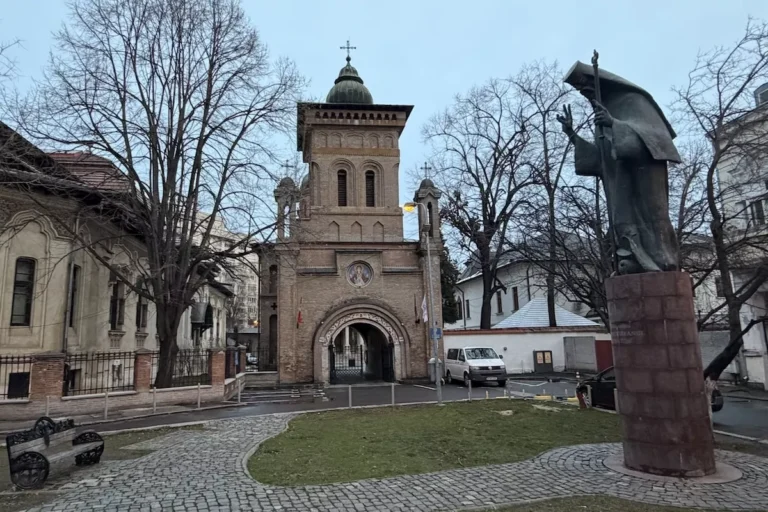
Yet, less than a ten-minute walk away, tucked behind a screen of nondescript apartment blocks, is the Antim Monastery (Mănăstirea Antim), perhaps the most serene “hidden gem” in the Romanian capital.
For the uninitiated tourist, Bucharest can feel like a city of sharp contrasts, Belle Époque elegance clashing with brutalist gray. Antim represents a third, often overlooked layer: the spiritual and artistic refinement of the early 18th century, miraculously surviving in the shadow of urban transformation.
A masterpiece of Brâncovenesc style
Built between 1713 and 1715, the monastery was founded by Antim Ivireanu, a Metropolitan of Wallachia originally from Georgia (Iviria). Ivireanu was not just a cleric; he was a scholar, a polyglot, and a master printer who played a pivotal role in the development of the Romanian written language.

Upon entering the arched gateway, the noise of the city vanishes. You are greeted by a meticulously kept garden, filled with roses and the scent of basil and incense. The centerpiece is the church itself. While the current façade reflects 19th-century restorations, the interior preserves the original layout.
The architectural style is classic Brâncovenesc, a unique Romanian fusion of Byzantine, Ottoman, and late Renaissance influences. Look for the ornate stone carving, the flowery columns, and the balanced proportions that define this era.
The door of mystery
One of the monastery’s most famous artifacts is the massive oak entrance door, carved by Antim Ivireanu himself. It is a dark, heavy testament to the founder’s artistic skill.
Keep an eye out for a small, peculiar detail near the base of the columns or in the decorative motifs: the snail. Ivireanu adopted the snail as his personal emblem. It symbolized humility, patience, and the idea of carrying one’s home (faith) wherever one goes, a fitting metaphor for a man who traveled from Georgia to become a pillar of Romanian culture.
Survival by slide
The serenity of Antim is deceptive, its survival was a violent struggle. In the 1980s, Nicolae Ceaușescu’s “systematization” project leveled large swathes of historic Bucharest to make way for the Civic Center and the People’s House (now the Parliament).

Antim was slated for destruction. Instead, in a feat of engineering desperation known as “translation,” the Synodal Palace (part of the complex) was lifted onto rails and moved 25 meters to save it from the bulldozers. While the church remained in place, it was boxed in by tall communist apartment blocks, effectively hiding it from the main boulevard.
The library of the Holy Synod
The complex houses the Library of the Holy Synod, containing rare manuscripts and ancient books. This continues the legacy of Ivireanu, who established a printing press here in the 1700s, producing books that spread literacy and faith across the Balkans.
Why you should visit
Bucharest is a loud city. It is vibrant, chaotic, and energetic. But every traveler needs a moment of pause. Antim Monastery offers a rare glimpse into the soul of old Wallachia. It is a place to sit in the shade, admire centuries-old craftsmanship, and watch the monks quietly tending to the grounds while the 21st century rushes by just over the wall.
Visitor Information:
- Location: Mitropolit Antim Ivireanu Street, No. 29 (Just off Piața Constituției, only 100 meters from the Unirii Boulevard).
- Best Time to Visit: Early morning for mass, or late afternoon for golden-hour light in the garden.
- Etiquette: Modest dress is required. Silence should be observed in the courtyard.