


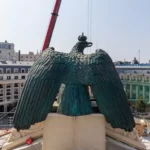


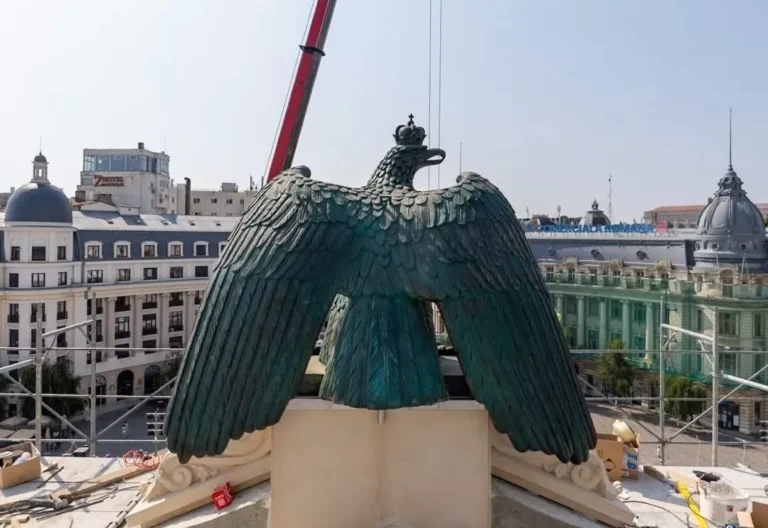
More than eight decades after they were destroyed during the bombings of 1944, the monumental eagle and two griffins that once crowned the University Palace in Bucharest have returned to the building’s pediment.
The return of the sculptures represents the first stage in the complete reconstruction of the University Palace’s original pediment. According to the University of Bucharest, the restoration project is expected to continue over the next two years, with the ultimate goal of recreating the entire sculptural composition designed by architect Alexandru Orăscuand executed by Karl Storck between 1862 and 1869.
A 1.6-tonne return to Bucharest’s skyline
The newly installed ensemble is made entirely of bronze and weighs approximately 1.6 tonnes. The central eagle alone weighs around one tonne, while each of the two griffins weighs approximately 300 kilograms.
The sculptures were produced using the traditional lost-wax bronze casting technique, followed by chiselling and patination. The process was designed to remain faithful to Storck’s original work while recreating sculptures that had disappeared from the building more than 80 years ago.

The scale of the restoration is significant. These are not decorative elements that can simply be placed back on a façade: the sculptures form the central visual composition of the historic pediment and were conceived as an integral part of the building’s architectural identity.
The lost masterpiece above the University Palace
The original pediment of the University Palace was designed in the Neoclassical style and was known as “Minerva Protecting the Arts and Sciences.” Its composition was inspired by the Glyptothek in Munich, one of Europe’s most important neoclassical museums.
The artistic concept was created by Romanian painter Theodor Aman, while the monumental bas-relief was carved in Rusciuc stone by sculptor Karl Storck and his collaborators. At the centre of the composition stood Minerva, the Roman goddess of wisdom, depicted crowning the sciences and the arts.
Around her were allegorical figures representing academic disciplines and the fine arts, turning the façade itself into a visual celebration of knowledge. Above the pediment, on the acroterion, stood the ensemble that has now returned: a crowned eagle flanked by two griffins.
The symbolism was deliberate. The eagle and griffins represented the protection of the state over knowledge and over the university institution itself, placing education and scholarship at the very top of the building, both literally and symbolically.

The entire composition was one of the defining features of the University Palace for almost a century. Then came 1944 and the original sculptural ensemble was almost completely destroyed during the bombing of Bucharest. In the post-war reconstruction, the central façade was simplified, while the sculptures that had defined the appearance of the University Palace for generations disappeared from the building.
A 2 million lei restoration project
The approximately RON 2 million investment in the eagle and griffins forms part of a much larger project involving the consolidation, restoration and modernization of the University Palace. The University of Bucharest describes itself as the largest educational building in Romania, covering more than 45,000 square metres.
The restoration is intended to combine the preservation of the building’s historical character with the requirements of a modern educational institution. The reconstruction of the pediment is expected to continue for another two years, gradually bringing back the complete sculptural ensemble originally conceived by Orăscu and Storck.