




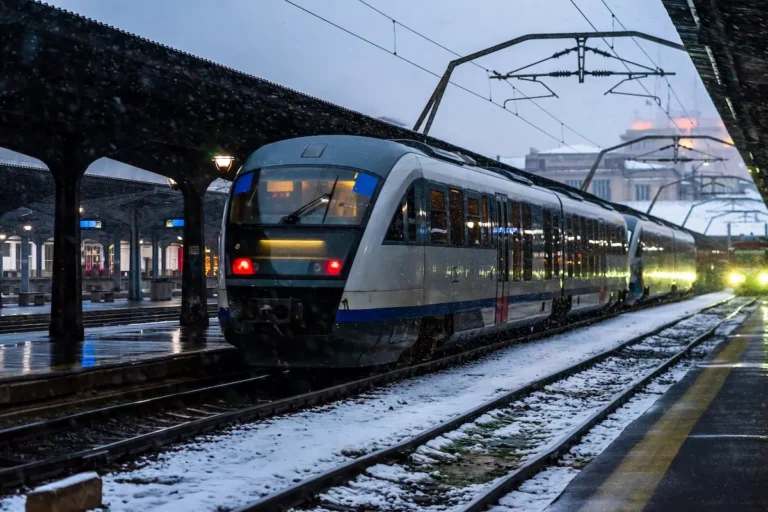
A routine international rail journey turned into a grueling 26-hour endurance test this week, as the “Muntenia” Express (IR 79) traveling from Budapest to Bucharest suffered one of the most significant delays in recent Romanian history.
What should have been a 16-hour trip ended in an 10-hour-and-21-minute delay, leaving passengers stranded in sub-zero temperatures as the national carrier, CFR Călători, struggled with cascading mechanical failures.
The train departed Budapest at 3:10 PM on January 8th and entered Romania through Curtici with a manageable 78-minute delay. However, once on Romanian soil, the journey spiraled into chaos.
A cascade of failures
The ordeal began at Vinga, just 25 kilometers from Arad, when the primary locomotive, which had been modernized using EU Recovery and Resilience Facility (PNRR) funds, suffered a total mechanical failure.
The situation transitioned from a delay to a crisis when the relief locomotive sent to rescue the train also broke down. Passengers were left waiting for nearly five hours before a functioning engine could be secured to continue the journey.
The official defense: Frost and friction
In a press statement, CFR Călători cited a “perfect storm” of technical and environmental factors:
- Successive Breakdowns: Both the towing locomotive and the initial replacement unit failed.
- Maneuvering Delays: Complex shunting maneuvers on public infrastructure took significantly longer than anticipated under frozen conditions.
- Speed Restrictions: Pre-existing speed limitations imposed by CFR SA (the infrastructure manager) further throttled the train’s ability to recover time.
- External Factors: Weather conditions in Hungary had already pushed the train behind schedule before it crossed the border.
Infrastructure under the microscope
The failure of a PNRR-modernized locomotive is a particularly bitter pill for the Romanian Ministry of Transport. Billions of euros have been earmarked for the “rejuvenation” of the national fleet, yet the “Muntenia” incident suggests that cosmetic upgrades may not be enough to combat the systemic fragility of the network during extreme winter events.
While the train finally pulled into Bucharest’s Gara de Nord at 6:44 PM, over 10 hours late, the “Muntenia” delay has reignited a national debate over the reliability of the state rail operator.