






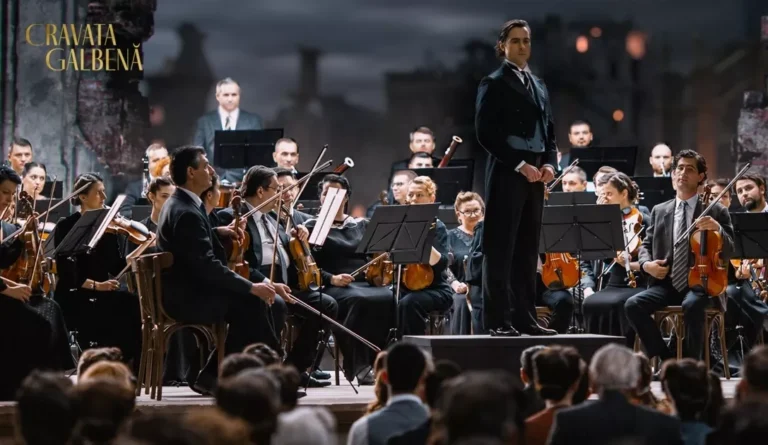
Serge Ioan Celibidachi’s The Yellow Tie, a family-driven biopic about his father, the legendary Romanian-born conductor Sergiu Celibidache, makes a persuasive case for the power of obsession. More than a conventional life story, the film shows how one man’s singular passion and stubbornness could reshape not only orchestral practice, but the very way the world listens to music.
What the movie captures best is the intensity of Celibidache’s artistic temperament. It dramatizes the paradox that defined him: a conductor who refused, for deeply held, often exasperating reasons, to bend art into a recorded commodity, and who demanded, sometimes painfully, that orchestras meet him in the fragile, unrepeatable moment of live performance. Music, for Celibidache, existed fully only in the instant it was created.
The Yellow Tie traces his journey from an interwar Romanian household through hunger, exile, and displacement to the great podiums of Europe. In doing so, it argues that his Romanian roots, the discipline, the hunger, the sense of both gift and exile, were not incidental, but catalytic.
The narrative is careful not to reduce Celibidache to a simple national symbol. Yet it deliberately leans into the drama of a Romanian who conquered global musical stages by sheer will, passion, and singularity. His rise is presented not as a smooth ascent, but as a hard-won confrontation with institutions, expectations, and an industry increasingly oriented toward speed and reproduction.

Beyond the life of one man, the film poses a larger question: what is the value of art in an age of instant consumption? Celibidache’s refusal to court the recording market is reframed here as prophetic, an argument for depth over immediacy, for patience over accessibility, and for presence over permanence.
In this sense, The Yellow Tie is less a straightforward historical account and more a rallying cry: for conviction, for rigor, and for allowing music to remain an event rather than a product. For Romanian audiences, the film resonates as a cultural triumph, for international viewers, it serves as a reminder that world-class art often emerges from unlikely routes and uncompromising minds.
Ultimately, The Yellow Tie stands as a passionate, beautifully staged tribute that brings Sergiu Celibidache’s forceful artistry back into public conversation. It succeeds most powerfully as a character study: a portrait of a Romanian boy who refused to compromise, and, by doing so, altered global expectations of what conducting, and musical devotion, could be.