



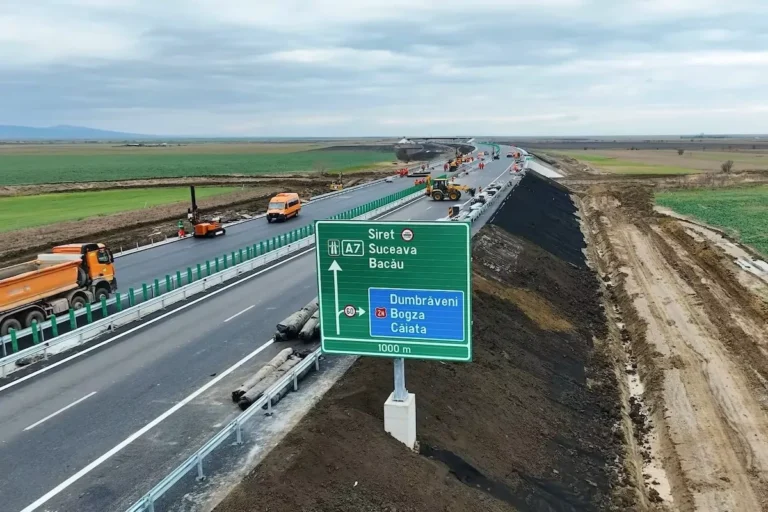
Romania has officially crossed a major infrastructure threshold to end the year, surpassing 1,400 kilometers of high-speed roads following the inauguration of a critical sector of the A7 ”Moldova” Highway just days before Christmas.
On Tuesday, December 23, the 50-kilometer segment connecting Focșani to Adjud was officially opened to traffic. This latest addition allows drivers to travel uninterrupted on highway-profile roads from Bucharest (A3/A0) all the way to Adjud.
The ”backbone” of Moldova takes shape
For decades, traffic to the north-east has been funneled through the notorious DN2 (E85), often dubbed ”the road of death” due to its high accident rate and insufficient width. The new A7 sector absorbs a significant portion of this traffic, offering a safer, modern alternative.
”This is not just asphalt; it is an economic lifeline,” said a Ministry of Transport spokesperson at the inauguration ceremony. ”For the first time in history, you can drive nearly 250 kilometers from the capital into the heart of Moldova without leaving the highway.”

The opening of the Focșani-Adjud lot is the crowning achievement of a prolific year for Romanian infrastructure. According to the National Company for Road Infrastructure Administration (CNAIR), the national network now stands at approximately 1,416 kilometers of expressways and motorways.
While the Focșani-Adjud sector is fully operational, construction continues at a feverish pace on the subsequent lots towards Bacău and Pașcani. Authorities remain optimistic that the remaining links to Pașcani will be completed in 2026.
2025 in numbers
The year 2025 ends with nearly 200 kilometers of new high-speed roads added to the Romanian map, one of the most productive years in the country’s history. Key deliveries included:
- The final segments of the A0 Bucharest Ring Road (South).
- Multiple lots of the A7 (Ploiești-Buzău-Focșani-Adjud).
- Completion of DEx12 (Craiova-Pitești).
The focus for 2026 will shift to the difficult mountain sectors of the A1 (Sibiu-Pitești), crucial for completing the corridor to Western Europe, and the continuation of the A7 northward to Suceava and Siret.